Published: 07 July 2026
For enterprise trading businesses, inventory allocation directly affects revenue, customer commitments, and fulfillment performance. When high-volume orders come in from strategic customers, supply chain teams need more than basic inventory visibility — they need the ability to reserve inventory with precision, protect customer-specific supply, and respond quickly when demand or supply conditions change.
Oracle Fusion Cloud provides these capabilities through the Manage Reservations and Picks page within Oracle Fusion Cloud Inventory Management. While Order Management initiates and orchestrates demand, reservation, picking, and shipment execution take place within Inventory Management, with fulfillment updates communicated back through the order orchestration process.
For organizations moving from Oracle E-Business Suite R12 to Oracle Fusion Cloud, these capabilities provide greater flexibility and control over inventory reservation and fulfillment processes.
How Do You Reserve a Sales Order Against a Specific Purchase Order in Oracle Fusion?
Trading businesses often face sudden demand spikes from strategic customers, prompting the creation of a dedicated purchase order to fulfill a specific customer requirement.
The challenge is what happens next.
Once the goods are received, how does the business ensure that the incoming quantity is protected for the customer it was intended for rather than being consumed by other open sales orders?
Oracle Fusion addresses this requirement through reservation capabilities available within the Manage Reservations and Picks page.
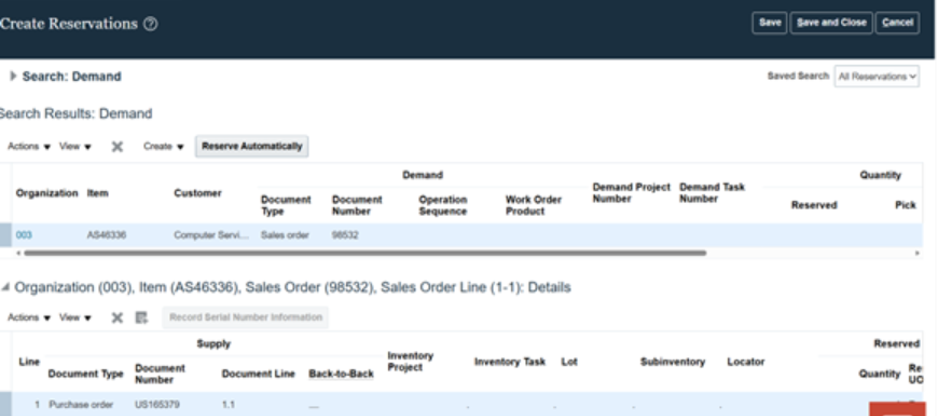
Users can query sales order demand and create reservations against eligible supply sources, including on-hand inventory and supported incoming supply sources such as purchase orders or transfer orders.
When a purchase order is selected as the supply source, users can identify eligible supply associated with the relevant inventory organization and item and create the appropriate reservation.
This gives supply chain teams greater system-driven control over customer-specific inventory allocation instead of relying on spreadsheets, emails, or side conversations to protect strategic supply.
The result is improved reservation accuracy, better inventory visibility, and greater confidence in meeting customer fulfillment commitments.
Fusion vs. R12: How the Reservation Model Differs
| Capability | Oracle Apps R12 | Oracle Fusion Cloud |
|---|---|---|
| Reservation Management | Reservation processes often required users to work across multiple forms and supply execution processes | Centralized reservation management capabilities through modern Inventory Management pages |
| Re-sourcing Supply | Changes to supply allocation could require additional manual processing depending on the fulfillment model | Greater flexibility to manage and adjust reservations as supply conditions change |
| Advance Demand Without a Sales Order | Businesses often relied on workarounds or additional processes to protect inventory for anticipated demand | User-defined demand provides a native mechanism for creating and managing anticipated inventory demand |
| Manual Reservation for Back-to-Back Flows | Dependent on the specific EBS configuration and supply execution process | Supports reservation management against eligible supply sources when additional intervention is required |
| User Experience | Traditional forms-based navigation and transaction processing | Modern, task-based user experience with centralized reservation and pick management capabilities |
| AI-Assisted Reservation Management | Not available as a native EBS capability | Emerging AI-assisted capabilities can support conversational reservation management |
One of the key differences is the greater flexibility provided by the Fusion Cloud reservation framework.
In traditional EBS environments, changing the relationship between demand and supply could require users to perform multiple transaction steps or use business-specific workarounds.
Oracle Fusion Cloud provides a more flexible framework for managing reservations as supply conditions change.
For example, if supply becomes available from a more appropriate source, users can adjust the reservation strategy to better support fulfillment priorities and customer commitments.
This is particularly valuable for trading businesses where inventory availability, incoming supply, and customer priorities can change rapidly.
Can You Reserve Inventory Without Creating a Sales Order in Oracle Fusion?
Yes — through user-defined demand.
This capability addresses a common business scenario: a sales team is pursuing a large opportunity that has not yet been confirmed, but the organization wants to protect inventory in anticipation of the order.
In traditional environments, businesses sometimes created placeholder or dummy sales orders to reserve inventory in advance.
While this approach could protect supply, it also introduced operational risks and additional administrative effort. A transaction created only to reserve inventory could accidentally progress further into the fulfillment process or require additional manual intervention to manage and cancel.
Oracle Fusion eliminates the need for this type of workaround through user-defined demand.
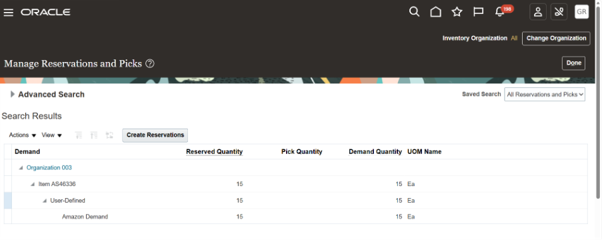
Teams can create demand for a specific item and quantity against an inventory organization directly from the Manage Reservations and Picks page without requiring an actual sales order.
The reserved quantity can then be protected from allocation to other demand while keeping the Order Management process clean.
Once the opportunity is confirmed and an actual sales order is created, users can relieve the user-defined demand and create the appropriate reservation against the confirmed customer order.
This strengthens process governance, reduces fulfillment risk, and gives sales and supply chain teams a more controlled way to plan for strategic demand before an order is finalized.
What Happens When Automated Supply Isn't Enough?
Even with automated orchestration processes in place, there may be situations where available or automatically created supply is not sufficient to fulfill demand.
This can be particularly important in back-to-back fulfillment scenarios.
When additional supply intervention is required, authorized users can review the demand and create or manage reservations against eligible supply sources, such as purchase orders, transfer orders, or available on-hand inventory.
This gives supply chain teams the ability to respond to supply shortages and changing fulfillment priorities while maintaining visibility and control within the Oracle Fusion environment.
For organizations handling lot- or serial-controlled inventory — common in regulated industries, high-value products, and businesses managing dated or traceable inventory — reservation processes can also incorporate lot and serial control requirements.
This enables organizations to manage inventory allocation at a more detailed level than simply reserving a generic quantity.
One Page, Broader Reach: Beyond Order Management
The Manage Reservations and Picks page is not limited to sales order fulfillment.
Reservation management capabilities can also support material requirements associated with manufacturing work orders, including project-based manufacturing scenarios.
Depending on the organization's configuration and business processes, project-related attributes and supply controls can determine how project-specific and common inventory are used to fulfill demand.
For trading businesses that also perform light manufacturing, assembly, configuration, or kitting operations, this provides an important advantage.
The same reservation management framework can support inventory allocation across both trading and manufacturing supply chain processes.
This helps organizations maintain greater consistency in how inventory is protected, allocated, and consumed across different operational requirements.
What's Next: AI in Reservation Management
Oracle is continuing to introduce AI capabilities across its Fusion Cloud Applications portfolio, including AI-assisted experiences for supply chain and inventory management.
The Inventory Reservation Assistant represents an emerging approach to simplifying reservation management through conversational interaction.
Instead of navigating multiple pages and manually searching for reservation information, users can interact with an AI-assisted experience to help create, review, and manage inventory reservations.
This can be particularly valuable in fast-paced, just-in-time fulfillment environments where supply conditions and customer priorities change frequently.
For example, when customer service needs to expedite a strategic customer order, users may need to quickly understand existing reservations, available inventory, and potential allocation options.
AI-assisted reservation management has the potential to make these activities faster and more intuitive.
For enterprise trading businesses developing their Oracle Fusion roadmap, this is an important trend to watch.
Reservation management is evolving from a primarily transactional activity toward a more intelligent and assisted decision-making process.
A More Flexible Reservation Framework for Modern Supply Chains
The Manage Reservations and Picks capabilities in Oracle Fusion Cloud demonstrate how modern cloud-based supply chain management can strengthen inventory control without adding unnecessary process complexity.
For enterprise trading businesses, these capabilities can support:
- More precise inventory allocation
- Greater protection of strategic customer supply
- Improved fulfillment reliability
- Faster response to changing supply conditions
- Reduced dependency on spreadsheets and manual tracking
- Better visibility across demand and supply
- More consistent reservation processes
- Greater control over inventory allocation decisions
By replacing manual workarounds and disconnected reservation processes with system-driven reservation management, Oracle Fusion Cloud helps organizations improve fulfillment reliability while maintaining the flexibility required by modern supply chains.
For supply chain executives evaluating a move from Oracle EBS R12 to Oracle Fusion Cloud, reservation management is a practical example of the operational value cloud modernization can provide.
The decision to migrate is not only about technology platforms, licensing, or application support lifecycles.
It is also about enabling supply chain teams to respond faster, allocate inventory more intelligently, improve customer commitments, and operate with greater visibility and control.
Frequently Asked Questions (FAQ)
Ready to Improve Inventory Allocation and Fulfillment with Oracle Fusion Cloud?
For enterprise trading businesses, moving to Oracle Fusion Cloud is more than a technology modernization initiative.
It is an opportunity to improve how inventory is allocated, how strategic customer demand is protected, and how supply chain teams respond to constantly changing fulfillment priorities.
ennVee helps organizations evaluate, implement, optimize, and extend Oracle Fusion Cloud supply chain solutions based on real-world operational requirements.
Whether you are planning a migration from Oracle EBS R12, optimizing an existing Fusion Cloud environment, or looking to improve your Order Management and Inventory Management processes, our team can help you build a more connected, flexible, and intelligent fulfillment operation.
Talk to our team about transforming your Oracle Order Management and inventory fulfillment processes.