Published: 10 August 2026
NetSuite continues to invest deeply in Artificial Intelligence across its solution stack — expanding its capabilities from Analysis and Assistance to the next frontier of Agents, Global AI Collaboration, Guided Operations, and Autonomous Decision-making, all delivered through its next-generation AI platform, NetSuite Next.
Why AI in NetSuite Matters for Enterprise Leadership and Accounting Teams
For CFOs, controllers, and finance operations leaders, AI inside NetSuite is not a novelty feature — it is quickly becoming core infrastructure for how enterprises close the books, manage risk, and forecast cash. As AI capabilities move from experimental to embedded, finance and accounting teams gain faster reconciliation, earlier exception detection, more accurate payment forecasting, and reduced manual data entry — all without leaving the ERP system of record. For enterprise leadership more broadly, this means shorter close cycles, stronger financial controls, and more reliable, real-time data to support strategic decision-making.
NetSuite Features That Use AI
In the previous article, AI in NetSuite, we covered the general context of AI in the ERP world and a high-level overview of AI-powered features in Oracle NetSuite. In this article, we go deeper into the complete presence of AI inside NetSuite — across every area and form it takes. NetSuite continues to release new AI features and AI-enabled functionality in every dot release, so it is always worth reviewing the release notes to stay current on the latest updates.
The following sections outline the five NetSuite zones that use AI, with references to help topics for further detail:
- Generative AI Features
- SuiteScript AI Modules
- Skills and Agents
- AI Integration Features
- Machine Learning Features
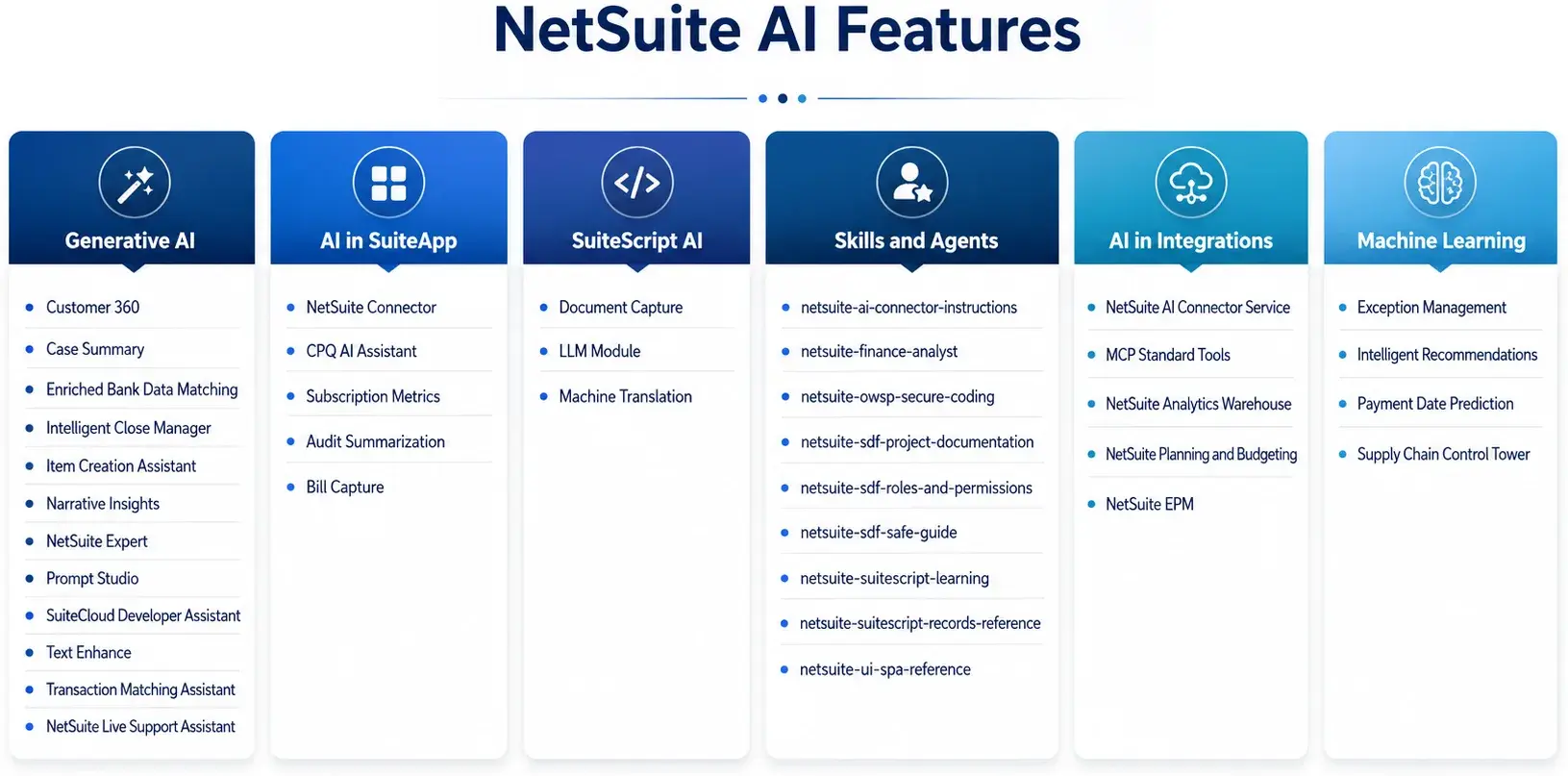
I. Generative AI Features
Now that we understand what Generative AI is, we can focus on the outcomes of this capability inside NetSuite. It is also important to understand how Generative AI features are architected within the platform. In principle, NetSuite's Generative AI features draw on multiple third-party AI models from various vendors. The following LLM models are currently leveraged to power NetSuite's Gen AI capabilities:
- Cohere Command A
- OpenAI GPT-OSS
- OpenAI GPT 5.x
- OpenAI GPT 4.x
- GPT-OSS
Because the LLM models used inside NetSuite are continually updated, later NetSuite releases may introduce additional models or retire some of those listed above. Some of these models are configurable, and alternates can be selected via NetSuite's AI preference options or specific AI configuration pages.
The table below maps NetSuite's key Generative AI features to the AI model(s) that power them.
| Feature Name | AI Model Used |
|---|---|
| Case Summary | Not specified in current NetSuite documentation |
| Customer 360 | Not specified in current NetSuite documentation |
| Enriched Bank Data for Transaction Matching | Cohere Command A |
| Intelligent Close Manager & Task Prioritization | OpenAI GPT 4.x |
| Item Creation Assistant | Cohere Command A |
| Narrative Insights | Cohere Command A, OpenAI GPT-OSS |
| NetSuite Expert (in SuiteAnswers) | Cohere Command A |
| Prompt Studio | Cohere Command A and OpenAI GPT-OSS |
| SuiteCloud Developer Assistant (SDA) | OpenAI GPT 5.x |
| SuiteScript 2.1 N/llm Module | Cohere Command and OpenAI GPT-OSS |
| Text Enhance | Cohere Command A or GPT-OSS |
| Transaction Matching Assistant | Cohere Command A |
| NetSuite Live Support Assistant | Cohere Command A |
Generative AI in NetSuite SuiteApps
Beyond NetSuite's standard features, Generative AI also plays a key role in several SuiteApps. The first three SuiteApp AI features below use the Cohere Command model to perform their operations:
- NetSuite Connector — The NetSuite AI Connector Service, enabled via the MCP Standard Tools SuiteApp. It is typically integrated with NetSuite Expert.
- NetSuite CPQ AI Assistant — Powered by Cohere Command A, this assistant ships alongside the NetSuite CPQ Configurator SuiteApp.
- Subscription Metrics AI Portlets — Powered by Cohere Command A and OpenAI GPT-OSS, these summary portlets use Prompt Studio and are available as part of the Subscription Metrics SuiteApp.
Two additional Generative AI capabilities extend this further:
- Audit Summarization — Uses the Oracle Cloud Infrastructure (OCI) Document Understanding Service to provide Generative AI summarization as part of the Compliance 360 SuiteApp.
- Bill Capture — Lets you email or upload vendor bill files to automatically create NetSuite vendor bills. This feature minimizes manual data entry and reduces the errors and inconsistencies that can occur during vendor bill entry. NetSuite also learns from user corrections over time, improving its suggestions. This feature works with the Transaction Email Capture SuiteApp.
II. SuiteScript AI Modules
SuiteScript AI APIs bring artificial intelligence capabilities directly into the NetSuite platform, letting developers automate, analyze, and enhance business processes using AI. These APIs leverage Oracle Cloud Infrastructure (OCI) services to enable large language model (LLM) interaction, language translation, and document extraction.
- Document Capture — The N/documentCapture module provides access to document extraction capabilities in scripts, letting you extract structured content and key information from document types such as invoices, receipts, and contracts in PDF, TIFF, PNG, or JPG format. This helps automate document processing, reduce manual data entry, and streamline business workflows. It uses the OCI Document Understanding AI Service.
- LLM Module — The N/llm module provides access to large language model (LLM) capabilities in scripts, letting you generate text, summarize content, and extract information using AI-driven models directly from SuiteScript code. This helps automate, enhance, or analyze business data using AI while integrating seamlessly with NetSuite workflows. This feature uses the OCI Generative AI service.
- Machine Translation — The N/machineTranslation module provides access to translation services in scripts, letting you translate text between supported languages. This helps teams work more effectively with multilingual content, localize business data, and improve user experiences for a global audience. It uses the OCI Language service.
III. Skills and Agents
Working with Agentic AI requires a basic understanding of Skills and Agents, and how each differs from standard operational functionality. Skills are typically techniques or tools that perform one kind of task, job, or activity on a repetitive basis. Agents, by contrast, are a more mature and intelligent system that plays a decision-making role, using skills to achieve a specific, targeted goal. In short: Skills are the building blocks; Agents orchestrate them to complete a specific business process.
SuiteCloud Skills are reusable packages that provide task-focused AI capabilities to help you automatically complete tasks in NetSuite. Skills use generative AI to interpret user intent and produce helpful, structured output.
SuiteCloud Agents & Skills form a platform-agnostic skill collection (tools) for coding assistants, built to be compatible with the agentskills.io specification. These skills focus on SuiteCloud and NetSuite development workflows — including SuiteScript, SDF, UIF SPA components, security, documentation, and deployment best practices — extending NetSuite development workflows with reusable, structured guidance for AI-assisted development and automation. These components help standardize processes, improve accuracy, and enforce best practices across SuiteCloud projects. Because Skills are reusable, they can be used across different coding agents (for example, Codex, Claude Code, and Cline); each Skill is self-contained and follows a consistent structure so agents can discover, load, and use it reliably.
IV. AI Integration Features
This section covers NetSuite integration features that use AI. Of the items listed below, NSAW, NSPB, and NSEPM are extended NetSuite modules that technically operate outside of the core NetSuite instance but remain fully integrated with it — and each has its own set of AI features.
- NetSuite AI Connector Service
- MCP Standard Tools SuiteApp
- NetSuite Analytics Warehouse (NSAW)
- NetSuite Planning and Budgeting (NSPB)
- NetSuite Enterprise Performance Management (NSEPM)
V. Machine Learning Features
Finally, the following list highlights the built-in Machine Learning AI features available in Oracle NetSuite:
- Exception Management — Helps identify transaction outliers, unusual activity, or other changes to normal transaction patterns. Exception Management highlights potentially incorrect transactions, unexpected activity, and suspicious vendor data changes so issues can be addressed before period close. Its AI models improve over time by learning from historical data and user actions: marking an exception as No Action Needed signals expected behavior, while resolving an exception after correcting a transaction confirms a true issue. Both signals help refine future suggestions.
- Intelligent Recommendations — Available both on Commerce websites and within core CRM transactions such as Opportunities, Estimates, and Sales Orders. When entering a sales order, estimate, or opportunity, users see intelligent recommendations based on the customer and items already selected. This behavior can be further controlled via the AI Preference page.
- Payment Date Prediction — Provides predictions for when customers are expected to pay invoices, generated using machine learning and available on the Invoices page and invoice forms. These predictions are based on historical payment data.
- Supply Chain Control Tower — Used to simulate inventory supply and demand across the supply chain. NetSuite uses these forecasting simulations (snapshots) to analyze whether inventory levels align with demand or planned levels. While this SuiteApp has been part of Oracle NetSuite for some time, it now uses Machine Learning capabilities to perform its operations more efficiently.
NetSuite Next
Here comes the next level of AI-based platform for NetSuite: NetSuite Next. NetSuite Next is a massive platform evolution that embeds conversational Artificial Intelligence, agentic workflows, and the modern Redwood Design System directly into the core of the NetSuite ERP. It allows users to query data in plain English and autonomously automate complex tasks — without altering underlying data or requiring a system migration.
We'll cover NetSuite Next in full detail in the next article.
Frequently Asked Questions (FAQ)
The FAQs below are structured to directly answer the most common search and voice-assistant queries about NetSuite AI — supporting both traditional SERP visibility and Answer Engine Optimization (AEO) for AI-driven search experiences.