Published: 29 July 2026
For any enterprise that leases rather than owns — warehouses, vehicle fleets, retail space, equipment, distribution assets — IFRS 16 changed the rules of the game. Nearly every lease now has to sit on the balance sheet as a liability and a corresponding Right-of-Use (ROU) asset. Footnote disclosure is no longer enough.
On paper, that's a reporting change. In practice, for any organization with more than a handful of leases, it's an operational one — and it's where a lot of finance teams quietly get stuck.
Quick note:
IFRS 16 requires continuous recalculation of lease liabilities and Right-of-Use assets every time a lease changes — which spreadsheets can't reliably track or audit at scale. Automating lease accounting inside an existing ERP (e.g., Oracle Fusion Cloud) removes the manual recalculation, creates a system-logged audit trail, and posts journal entries automatically, without requiring new software.
Why IFRS 16 Compliance Is Harder Than It Looks
IFRS 16 doesn't ask for a one-time recalculation. It asks for a continuous one. Every time a lease is modified, renewed, or re-measured — a rate changes, a term is extended, an index resets — the ROU asset and lease liability both need to be recalculated, and that recalculation needs to be traceable.
For a small, static portfolio, a well-built spreadsheet can hold up. But for an enterprise with a large, actively changing lease book, the model breaks down in three predictable ways:
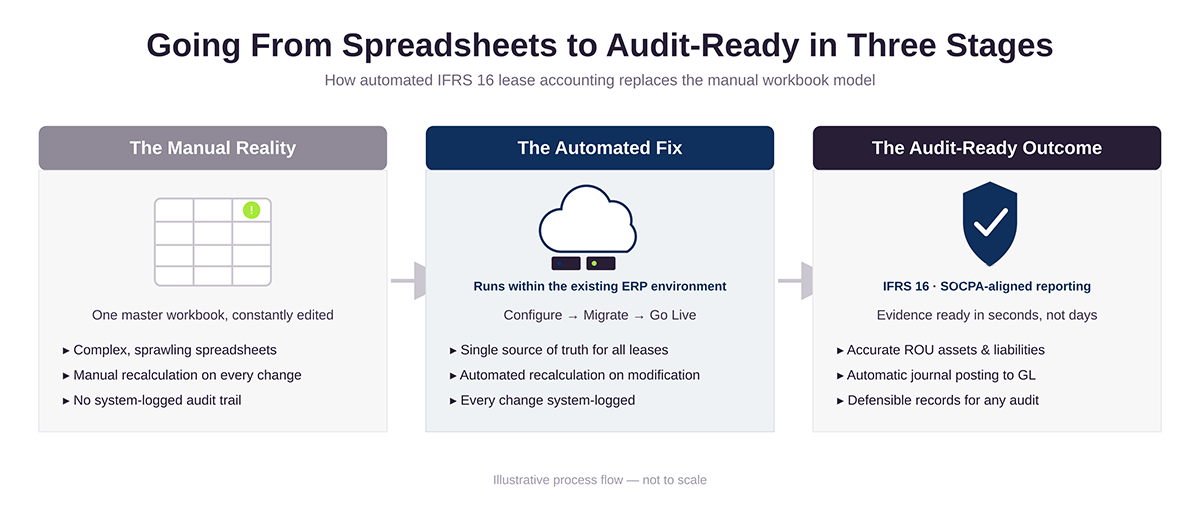
- Recalculation load — Every modification means manually re-entering a master workbook and re-deriving figures — often consuming days of skilled finance time on formula and cell-reference checks alone, time that isn't going toward analysis.
- No audit trail — Spreadsheets don't log why a number changed or who changed it. When an auditor asks about an incremental borrowing rate that shifted six months ago, the answer often lives in an email thread, not a system.
- Disconnection from the ledger — If the lease workbook sits outside the general ledger, someone has to re-key journal entries every month — a manual step that's slow and consistently exposed to error.
None of this shows up as a single dramatic failure. It shows up as accumulated risk — the kind that's invisible until an audit or a regulator asks the wrong question at the wrong time.
A Case in Point: Automating IFRS 16 at Scale
We recently worked with a large enterprise in the Gulf region managing a sizeable, regionally distributed portfolio of leased facilities and operating assets. The setup was a familiar one: a single, highly complex spreadsheet functioning as the system of record for lease accounting, maintained by a small team under constant pressure to keep it current.
Renewals, renegotiated terms, and index-linked rate changes were frequent enough that the workbook was in near-permanent flux. Every change triggered a manual recalculation cycle, and every month-end meant re-keying journal entries into the core financial system by hand.
We migrated the entire lease portfolio off spreadsheets and into a structured, automated lease accounting environment — consolidating and validating the legacy data, then establishing a single source of truth for every lease. The approach followed three stages:
- Configure — Define lease classifications, discount rates, and compliance parameters at the system level.
- Migrate — Consolidate and validate legacy lease data using secure, structured upload templates.
- Go live — Automate monthly journals, lease amendments, and lessor payments end-to-end.
Notably, this didn't require a new system or an additional license. IFRS 16 lease accounting is embedded functionality within the client's existing Oracle Fusion Cloud Financials environment — specifically Fusion Assets and Payables. The real work wasn't procurement; it was configuration — getting classifications, discount rates, and account mappings set up correctly so the automation could be trusted.
The result was immediate. Lease modifications now trigger automatic recalculation — depreciation, interest accrual, and mid-term amendments all processed without manual formula work. Every change is captured as a permanent, system-generated record, so audit evidence that once took days to reconstruct is now available in seconds.
What Changed, Concretely
- Manual recalculation for lease modifications, renewals, and rate changes was eliminated
- Every lease event now has a permanent, audit-ready digital trail
- Monthly journal entries post automatically to the general ledger
- The enterprise now has one source of truth for its lease portfolio, replacing fragmented spreadsheets
- Finance capacity shifted from error-correction to actual financial analysis
The bigger shift was cultural as much as technical: the finance function moved from reactively firefighting spreadsheet errors to operating as the strategic partner the business actually needed.
IFRS 16 Regulatory Requirements in the Gulf Region
This matters beyond good practice. In several jurisdictions across the region, IFRS 16 is not just an international standard — it's a local regulatory requirement. In Saudi Arabia, for instance, SOCPA (the Saudi Organization for Chartered and Professional Accountants) adopted IFRS 16 for local use effective January 1, 2022, replacing the earlier IAS 17 standard.
For enterprises operating under this kind of regime, automated, system-logged lease accounting isn't just operationally convenient — it's what makes a compliance conversation with auditors and regulators a straightforward one, rather than a reconstruction exercise.
The Takeaway
Spreadsheet-based lease accounting can hold up at small scale. It doesn't hold up once a portfolio is large, distributed, and constantly changing — at that point, the spreadsheet itself becomes the risk. Moving to a centralized, automated IFRS 16 process doesn't just satisfy an auditor; it converts a growing operational liability into a controlled, scalable system, and frees the finance team to spend its time on judgment rather than upkeep.
If you're a finance leader watching your own lease portfolio outgrow what your spreadsheet can safely handle, this is a solvable problem — and one we've solved before. Get in touch with ennVee to talk through what an automated, audit-ready IFRS 16 setup could look like for your organization.