Last Updated: 16 June 2026 | Published: 02 February 2019
Each quarter, Oracle releases new Critical Patch Updates and Patch Set Updates. For Oracle E-Business Suite R12.2 environments, applying these patches correctly is important for security, stability, and long-term system health.
This article explains how to approach CPU and PSU patching for Oracle EBS R12.2, with a focus on the database tier, middle tier, ETCC checks, overlay patches, and key MOS references used during the patching process.
Overview
In Oracle E-Business Suite (EBS) R12.2 several technology stack components must be considered during quarterly patching. These include:
- Forms and Reports
- Fusion Middleware - Web Tier
- Fusion Middleware - oracle_common Home
- WebLogic Server
- Database tier
The database is also a component of the EBS application environment. It should be included in the overall patching plan and not treated as a separate activity outside the EBS patch cycle.
A practical sequence is to apply the latest quarterly patches to the database tier first and then move to the application or middle tier.
CPU vs PSU in Oracle EBS R12.2
For the database tier, it is generally better to apply the latest Patch Set Update rather than only the Critical Patch Update. A PSU includes CPU security fixes along with proactive stabilization fixes that may address issues already encountered by Oracle customers.
For the Oracle EBS application or middle tier, Oracle releases Critical Patch Updates rather than PSUs. This distinction is important for Apps DBAs because the patching approach differs between the database tier and the EBS middle tier.
In simple terms:
- Database tier: apply the latest PSU and the corresponding OJVM patch.
- EBS middle tier: apply the relevant CPU patches and required technology stack fixes.
- ETCC should be run before and after patching to identify missing patches or gaps.
Database Tier Patching
- Apply the latest PSU and OJVM patch
Always try to apply the latest PSU patch available along with the corresponding OJVM patch. Since CPU and PSU patches are cumulative, teams do not need to apply every skipped quarterly release sequentially. - Apply the latest PSU and OJVM patch
Run ETCC before patching. The ETCC script can be downloaded from Patch 17537119. Always use the latest version of ETCC when running checks.
ETCC has two scripts:
- checkDBpatch.sh: run this on the database tier.
- checkMTpatch.sh: run this on the application or middle tier.
Run checkDBpatch.sh against the database to identify patches that need to be applied.
- Apply Proactive Bundle Patches where applicable
If the environment is running on Oracle Exadata or SuperCluster, apply the appropriate Proactive Bundle Patch. Select the correct release based on the newly applied PSU patch level. - Apply overlay patches
Overlay patches help resolve conflicts where certain patches do not coexist with the latest PSU patch. These should be reviewed and applied when required. - Apply standard or one-off patches
After overlay patches are addressed, apply the standard one-off patches relevant to the environment. These are usually environment-specific or issue-specific fixes. - Run ETCC again
Finally, run the DB tier ETCC script again, review missing patches, and take action where needed. This post-check helps confirm that required technology fixes have not been missed.
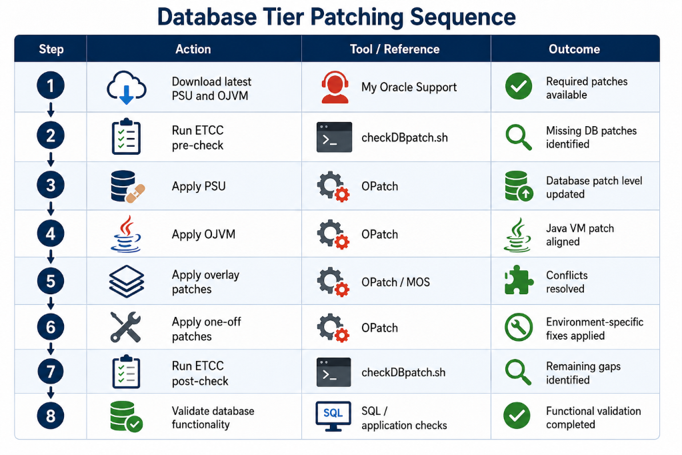
| Step | Action | Tool / Reference | Outcome |
| 1 | Download latest PSU and OJVM | My Oracle Support | Required patches available |
| 2 | Run ETCC pre-check | checkDBpatch.sh | Missing DB patches identified |
| 3 | Apply PSU | OPatch | Database patch level updated |
| 4 | Apply OJVM | OPatch | Java VM patch aligned |
| 5 | Apply overlay patches | OPatch / MOS | Conflicts resolved |
| 6 | Apply one-off patches | OPatch | Environment-specific fixes applied |
| 7 | Run ETCC post-check | checkDBpatch.sh | Remaining gaps identified |
| 8 | Validate database functionality | SQL / application checks | Functional validation completed |

Middle Tier Patching
For Oracle EBS, CPU patches are applied to the application or middle tier components. Unlike the database tier, Oracle does not release PSUs for the EBS middle tier. This is important for every Apps DBA to remember when planning quarterly patching.
Refer to the current Oracle E-Business Suite Release 12 Critical Patch Update Knowledge Document for the relevant quarter. The original reference used April 2018 as an example: Oracle E-Business Suite Release 12 Critical Patch Update Knowledge Document (Doc ID 2369524.1) For current execution, teams should use the latest quarterly CPU document applicable to their environment.
It is important to apply CPU patches across all relevant EBS technology stack components. During this phase, certain prerequisites may also need to be applied if they are not already present in the system.
Proactive Fixes and Patch Conflicts
Apart from CPU patches for Oracle EBS, there are proactive stabilization fixes for several technology stack components. Apps DBAs should review these fixes while planning the CPU patching exercise.
A key MOS reference for this is Oracle E-Business Suite Release 12.2: Consolidated List of Patches and Technology Bug Fixes (Doc ID 1594274.1).
While checking patches for each component, there may be conflicts between patches. In some cases, two patches cannot coexist. When that happens, first check whether Oracle provides a combination patch. If the conflict cannot be resolved from available MOS guidance, it is better to raise an SR with Oracle Support. In many cases, Oracle may already have encountered similar customer scenarios and can provide a resolution path.
Run ETCC before and after the exercise. After applying the middle tier patches, review suggestions from checkMTpatch.sh and apply missing patches as needed. ETCC primarily helps identify proactive technology fixes; it does not replace the need to review the current CPU knowledge document.
Pre-Patching Checklist
- Latest quarterly CPU documentation has been reviewed.
- Latest ETCC version has been downloaded from Patch 17537119.
- Database backup and application tier backup are validated.
- PSU, OJVM, overlay, and one-off patches are downloaded.
- Patch conflicts have been reviewed.
- Downtime window has been confirmed with business users.
- Development or test environment patching has been completed before production.
- Rollback approach is documented.
- Post-patch validation checklist is ready.
References
- Patch 17537119
- Oracle E-Business Suite Release 12 Critical Patch Update Knowledge Document - use the current quarterly document applicable to your environment. The original article referenced April 2018, Doc ID 2369524.1.
- Oracle E-Business Suite Release 12.2: Consolidated List of Patches and Technology Bug Fixes, Doc ID 1594274.1
Check out our other Oracle EBS R12.2 blogs for more guides and case studies.